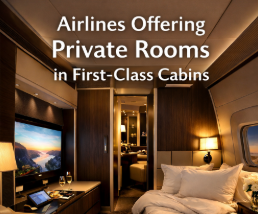
Luxury air travel has transformed dramatically over the past decade, and airlines offering private rooms in first-class cabins are now redefining what premium aviation truly means. First-class is no longer just about a wide reclining seat or champagne service; it has evolved into a fully enclosed private suite experience in the sky. Travelers today expect exclusivity, privacy, personalization, and cutting-edge design, and airlines are responding with first-class cabins that resemble boutique hotel rooms more than airplane seats.
If you think about it, commercial aviation has quietly entered a new era where ultra-premium airline suites compete directly with five-star hotels. The demand for privacy, especially among business executives, celebrities, and high-net-worth travelers, has pushed airlines to design fully enclosed suites with sliding doors, personal wardrobes, large entertainment screens, and even double beds. The keyword here is privacy, and it has become the ultimate currency in luxury air travel. Airlines are investing millions in cabin innovation because passengers are willing to pay premium fares for the feeling of owning a personal sanctuary at 40,000 feet.
This shift toward private rooms in first-class cabins isn’t accidental. Post-pandemic travel behavior accelerated demand for space and exclusivity, and airlines realized that offering private, enclosed suites significantly enhances both passenger comfort and perceived value. The result is a new category of aviation luxury that blends technology, hospitality, and design into one seamless first-class experience.
Why Private First-Class Rooms Are the Future of Luxury Aviation
The Psychology of Privacy in Premium Travel
Let’s be honest—why do travelers choose first-class? Comfort matters, of course, but the deeper reason is emotional. Privacy creates a sense of control, security, and status. When airlines introduce fully enclosed first-class suites, they tap into that emotional desire for exclusivity. A sliding door instantly transforms a seat into a personal domain.
Privacy in aviation luxury travel reduces noise, visual distractions, and interruptions. Business travelers can conduct meetings, review sensitive documents, or rest without exposure. High-profile passengers avoid public attention. Even leisure travelers enjoy the feeling of a personal cocoon. Airlines understand that emotional comfort is just as valuable as physical comfort, which is why private cabin suites in first-class are becoming a defining feature of flagship aircraft.
The psychological impact is powerful. When a traveler steps into a private suite with walls, a door, ambient lighting, and hotel-style bedding, the experience shifts from transportation to indulgence. The aircraft becomes a luxury residence in the sky.
Revenue Strategy Behind Private First-Class Cabins
From a business perspective, airlines aren’t adding private rooms out of generosity. These premium first-class suites generate significantly higher yields per square meter of cabin space. A single private suite can sell for tens of thousands of dollars on long-haul routes, particularly between global financial hubs.
Airlines calculate cabin revenue carefully. By reducing the total number of seats and replacing them with larger private suites, they create scarcity. Scarcity drives prestige, and prestige drives pricing power. In ultra-long-haul aviation, fewer but more exclusive seats often outperform higher-density cabin layouts.
The modern aviation revenue model shows that luxury travelers prioritize experience over price. For airlines competing in global markets, offering private rooms in first-class cabins is not just a branding strategy—it’s a profit optimization model built around premium demand.
Top Airlines Offering Private Rooms in First-Class Cabins
Emirates First Class Private Suites
When discussing airlines with private first-class suites, one name consistently dominates the conversation. Emirates introduced fully enclosed suites on its Boeing 777 fleet, featuring floor-to-ceiling doors and virtual windows for middle seats. These suites include leather seating, personal minibars, large HD screens, and customizable mood lighting.
The design philosophy centers on exclusivity. Each suite feels like a personal hotel room, complete with temperature control and privacy panels. Emirates markets this product as a “Game Changer,” and it truly reshaped industry expectations. On select aircraft, first-class passengers also enjoy onboard shower spas, enhancing the perception of unmatched luxury air travel.
Singapore Airlines Suites
Singapore Airlines elevated the concept of private first-class rooms with its redesigned Suites on the Airbus A380. These suites feature sliding doors, standalone leather chairs, and separate beds that fold down from the wall. When two adjacent suites are booked together, they can convert into a double bed configuration.
This design approach blurs the line between commercial aviation and private jet luxury. Passengers experience personalized dining, fine wine selections, and premium bedding from luxury brands. Singapore Airlines positions its Suites as the pinnacle of comfort in commercial aviation, targeting travelers who demand maximum privacy and elegance.
Etihad Airways First Apartment and The Residence
Etihad introduced one of the most innovative first-class concepts with its “First Apartment” on the Airbus A380. While technically not a fully enclosed room like a hotel suite, it provides significant personal space with a separate seat and bed.
Beyond that, Etihad’s “The Residence” redefines ultra-luxury aviation by offering a three-room private cabin with a living room, bedroom, and private bathroom with shower. This product essentially transforms a commercial flight into a private aviation experience, setting a benchmark for private room experiences in first-class cabins.
Features That Define Private First-Class Rooms
Fully Enclosed Sliding Doors
The defining feature of modern first-class private suites is the floor-to-ceiling sliding door. This architectural element converts an open cabin seat into a personal sanctuary. Noise reduction, visual privacy, and psychological comfort all increase significantly once the door closes.
Airlines design these doors with advanced materials to maintain safety standards while delivering maximum enclosure. This innovation marks a departure from older first-class cabins that relied only on partitions or curtains.
Luxury Bedding and Convertible Double Beds
One of the most sought-after features in airline private rooms is a fully flat bed with premium mattress toppers, designer bedding, and high-thread-count linens. In some suites, couples can combine two cabins into a double bed arrangement, enhancing romantic or family travel experiences.
This feature transforms long-haul flights into restful journeys rather than endurance challenges. Airlines invest heavily in sleep science, understanding that rest quality directly influences passenger satisfaction scores.
Personalized Dining and On-Demand Service
In private first-class suites, dining becomes a restaurant-quality experience. Passengers can order meals anytime, often curated by world-renowned chefs. Fine wines, caviar service, and bespoke plating elevate the experience beyond traditional airline catering.
Crew members are trained to provide discreet, attentive service without intruding on privacy. The result is a hospitality experience comparable to luxury boutique hotels.
Comparison of Leading Private First-Class Products
| Airline | Aircraft | Private Door | Double Bed Option | Shower Onboard | Ultra-Premium Branding |
|---|---|---|---|---|---|
| Emirates | Boeing 777 | Yes | No | Yes (A380 only) | Game Changer Suites |
| Singapore Airlines | Airbus A380 | Yes | Yes | No | Suites Class |
| Etihad Airways | Airbus A380 | Partial (Apartment) | Yes | Yes (Residence) | The Residence |
This comparison highlights how airlines offering private rooms in first-class cabins differentiate themselves through features, layout innovation, and branding strategy.
Technology Inside Private First-Class Suites
Modern private first-class cabins integrate advanced technology, including large 4K entertainment screens, wireless charging, personal temperature controls, and mood lighting systems. Some airlines even introduce virtual windows for middle suites, displaying real-time exterior views.
Technology enhances the perception of exclusivity. Noise-canceling headsets, touchscreen interfaces, and high-speed Wi-Fi allow passengers to work or relax seamlessly. The integration of digital innovation with cabin design signals the next phase of luxury airline suite development.
The Competitive Landscape of Ultra-Premium Aviation
As more airlines compete in the luxury aviation segment, private suites are becoming a benchmark rather than a novelty. Middle Eastern and Asian carriers have led innovation, while European and North American airlines are gradually upgrading their first-class products to remain competitive.
Competition drives design evolution. Airlines continually analyze passenger feedback, operational efficiency, and cost structures to refine their private cabin offerings. The race to deliver the most luxurious private room in the sky has become an industry-wide ambition.
Conclusion: The Sky Has Become the Ultimate Luxury Destination
The rise of airlines offering private rooms in first-class cabins represents a fundamental transformation in commercial aviation. Luxury air travel now mirrors five-star hospitality, where privacy, personalization, and exclusivity dominate the experience. Airlines that invest in private suite innovation position themselves at the forefront of premium aviation markets.
As global travel demand continues to rebound and premium passengers seek differentiated experiences, private first-class cabins will likely become even more advanced. The future may include biometric personalization, AI-driven service customization, and even larger cabin footprints dedicated to ultra-premium travelers.
For passengers willing to pay for unparalleled comfort and privacy, the sky is no longer just a route between destinations—it’s the destination itself.
Frequently Asked Questions
1. What makes a first-class suite different from business class?
A first-class suite typically offers full privacy with sliding doors, more personal space, higher-end dining, luxury bedding, and exclusive amenities that exceed standard business class features.
2. Are private first-class rooms available on all aircraft?
No, private first-class suites are usually installed on flagship long-haul aircraft like the Airbus A380 or select Boeing 777 models.
3. How much does a private first-class ticket cost?
Prices vary depending on route and airline but can range from several thousand to tens of thousands of dollars for long-haul flights.
4. Can couples share a private first-class suite?
Some airlines offer convertible suites that combine into a double bed, allowing couples to share a more intimate travel experience.
5. Is flying in a private first-class suite worth it?
For travelers prioritizing privacy, exclusivity, and personalized service, the experience often justifies the premium cost, especially on ultra-long-haul routes.
Read More :